

Continuous Effort Leads to Change
Persistent effort drives progress, fostering growth and transformative change
Without our ongoing initiatives, we would not achieve breakthroughs. Continuous efforts and sustained commitment are essential for driving innovation, making significant progress, and reaching groundbreaking discoveries and advancements.
If you would like to know more or participate in any of our studies, please contact our nurse, Susan Keast, for more information.
Ongoing Projects
GPS Clinic Research Program
When you join the clinic, you will be asked if you are interested in joining the paralleled research platform. You will be provided with information about the project, a consent form and, if you agree, you'll receive email surveys every few months. This will help us better understand how the service impacts people's health in the long term.
BRCA Previvor Study
In partnership with Ovarian Cancer Canada, we are studying how to better provide care and prevention to healthy BRCA carriers without cancer. We are conducting interviews with patients who have been working with our team through both the pre-op decision-making and post-operative care before and after risk-reducing salpingo-oophorectomy.
The SOROCk Trial is a clinical trial available to a particular group of individuals with inherited BRCA1 mutations. For these pre-menopausal individuals, the study is testing whether removal of just the fallopian tubes, with the plan to remove the ovaries at a later time, can reduce the risk of ovarian cancer to the same degree as the usual standard of care of removing both the ovaries and fallopian tubes.
CHARM Study
cfDNA in Hereditary And High-Risk Malignancies (CHARM) is a research initiative that collects longitudinal plasma samples, tumour tissue, genomic/epigenomic data, and clinical data on individuals with a hereditary cancer syndrome, regardless of personal cancer history.
Culture and Inheritance in Women's Health
A study of South Asian patient beliefs and needs regarding Hereditary Cancer Risk.
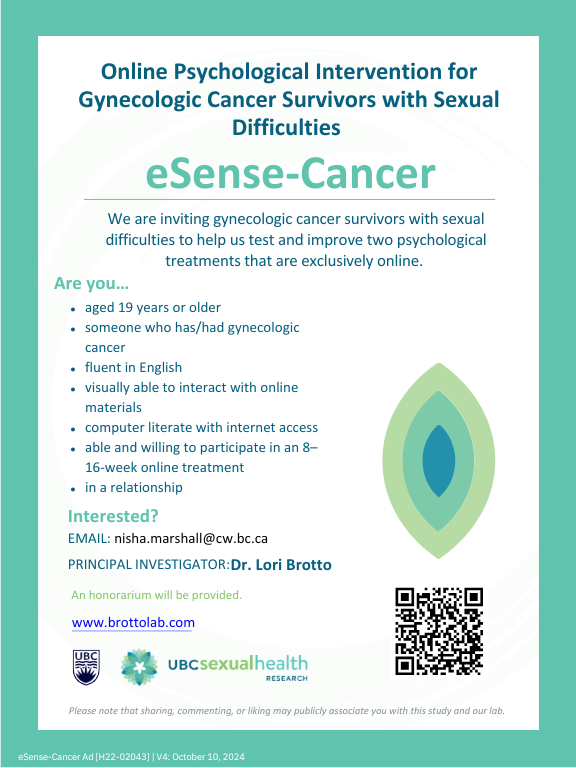
eSense Cancer
A research of cancer impact on sexual health and treating options for gynecologic cancer survivors.
TUBA-WISP II Study
TUBA-WISPII is a clinical trial for those who carry a BRCA1/2, BRIP1, RAD51C/D, or PALB2 genetic mutation and are planning their risk-reducing surgery. This trial looks at whether removing the fallopian tubes and delaying the removal of the ovaries, to delay surgically-induced menopause, is as effective at reducing one's risk of developing ovarian cancer as when the fallopian tubes and ovaries are removed at the same time.
Lynch-SCAN (Lynch Syndrome Carriers’ Uterine Cancer Health Assessment: Sampling and DNA-based Detection)
Lynch syndrome is an inherited cancer predisposition syndrome caused by specific gene mutations. Individuals with Lynch syndrome who have a uterus face over a 10 times greater risk of developing endometrial cancer compared to the general population. Some individuals have their uterus removed as a preventative measure, while those who still have their uterus may be offered annual transvaginal pelvic ultrasound testing and endometrial biopsies. However, they can be time-consuming and invasive, and are not widely recommended, resulting in low adherence to regular testing.
This project will evaluate if data collected from questionnaires and non-invasive biological tests (vaginal DNA and microbiome, pH) can be used to predict the risk of endometrial cancer in Lynch syndrome carriers in BC.
We are recruiting people who:
- Are carriers of Lynch syndrome confirmed by genetic testing
- Are aged over 30
- Have an intact uterus
Participation involves completing a health assessment questionnaire and up to three rounds of at-home sample collection.
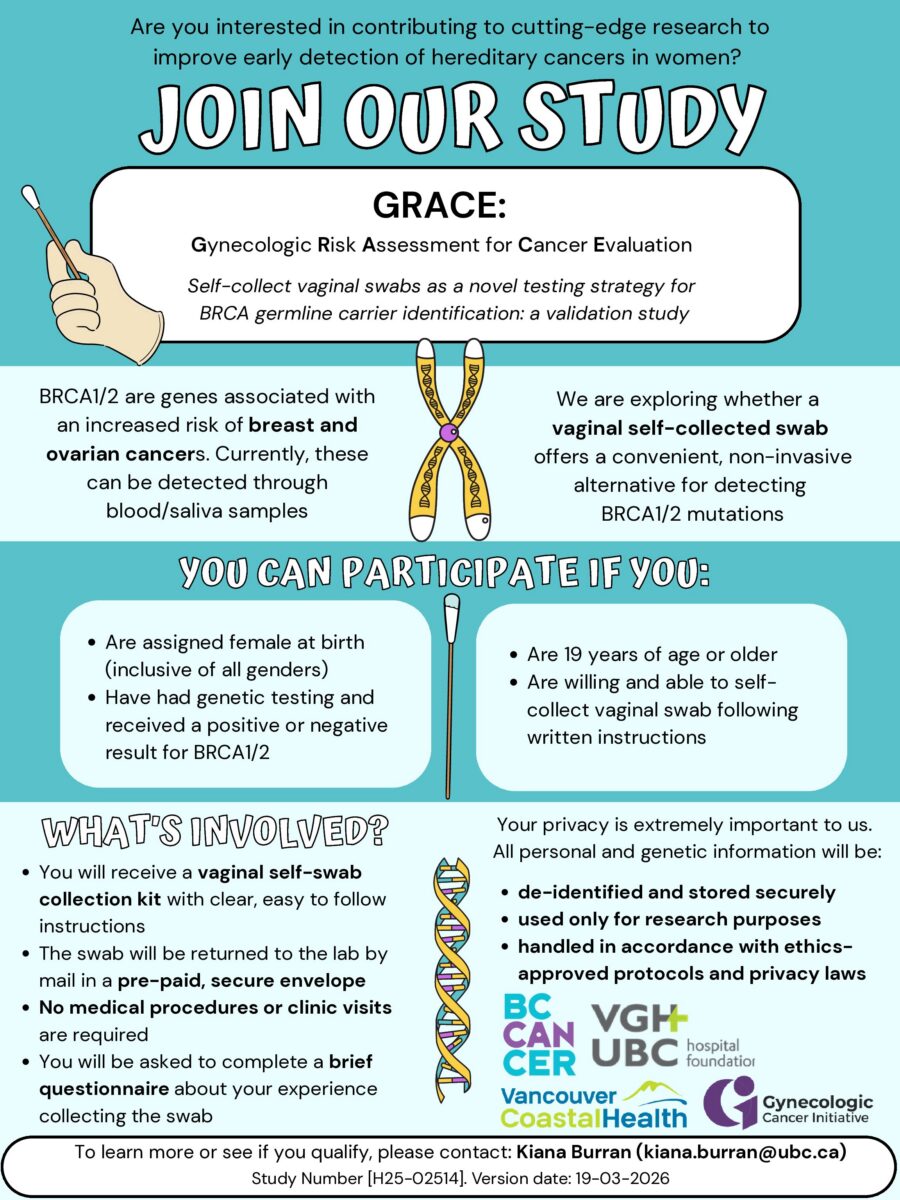
Vaginal SWAB for BRCA Patients
People with hereditary gene mutations like BRCA face a much higher lifetime risk of breast and ovarian cancer, reaching 75% and 44%, respectively. If identified through genetic testing, they can access critical screenings and preventative care. Currently, this testing is only available to those who have had cancer or have a strong family history. A new approach called Population-based Testing (PBT) would allow anyone to get tested and know their risk, no matter their background.
To roll out PBT, testing would be offered once in a lifetime to young people, using blood or saliva samples. This requires setting up a new program, including sample collection and patient access.
In 2023, BC's cervical cancer screening program introduced a new model where women receive a home self-collection swab kit to test for HPV, the main cause of cervical cancer. This study proposes that the same vaginal swabs could be used to detect BRCA gene mutations.
The study will address two main questions: 1) Can vaginal swabs collect enough DNA for BRCA testing? 2) Can these swabs accurately identify people with or without BRCA mutations?
Participants will include people with known positive and negative BRCA tests, who will use the self-collection swab kits. If successful, this research could pave the way for broader population-based testing and a combined program to assess women's cancer risk in BC.
Join Our Research
Help women like you.
